
By Martina Meyer
The kingfisher on the bridge: what happens when you say your wish out loud
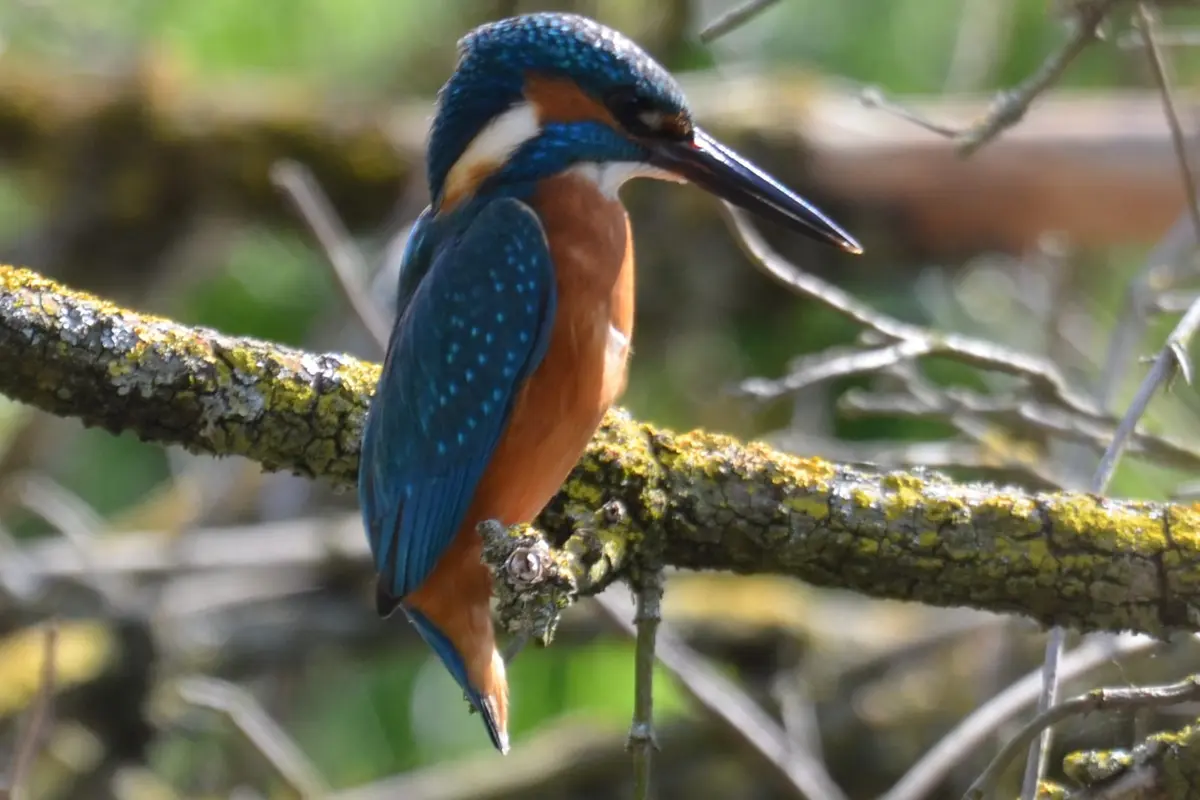
There are moments when life answers so promptly that you briefly believe in magic. I had one of those moments with my daughter — at a small bridge over a stream. I had only spoken a wish out loud. And then there he sat.
The wish and the bridge
It was one of those walks where you simply talk. My daughter — long since grown up — was visiting, and we were walking the old trails near Grevenbroich-Kapellen. Over the years, drainage ditches had become little streams, and a narrow bridge crossed the water over one of them.
I told her that I had once seen a kingfisher right there — that small, brilliantly blue bird that hardly anyone ever gets to see. And then I said, half joking: “It would be lovely if we came round the corner now and the kingfisher were sitting there on the bridge.”
We rounded the corner. We stepped onto the bridge.
And there he sat. Right before our eyes, in full splendour, the strong colours in his feathers close enough to touch. As if I had rubbed a magic lamp and the genie had appeared: “Your wish is my command.” Both of us utterly surprised, not a sound — until he noticed we had seen him, and flew away.
What a prompt granting of a wish.
No magic — just aimed attention
Now I could tell you the universe granted my wish. But I’m a mental trainer, not a magician — and I think the true explanation is even lovelier than any magic.
The moment I spoke the wish, something happened to me and to my daughter: our attention took aim. From then on, we were watching for a flash of blue over the water. We walked more slowly, we grew quieter, our eyes searched the bank. Without noticing it, we had turned into exactly the kind of people who can see a kingfisher at all.
Was the bird already there? Almost certainly. It was his territory. But on all the days I would have walked past carelessly — chatting, my mind elsewhere — on all those days he would simply have been a branch I never looked at.
That is a basic law of your mind: what you aim yourself at, you begin to see. A spoken wish is not a command to the world. It’s a command to your own attention.
Why saying it out loud makes the difference
I could have merely thought the wish. But I said it out loud — to someone I trust. And that is the part that works in everyday life.
A thought flits past. A spoken sentence stays. It turns a vague “that would be nice” into something clear that your gaze can hold on to. That is exactly the heart of any good affirmation — nothing esoteric, just a sentence that gives your attention a direction.
And it holds far beyond kingfishers. Whoever says in the morning “today I’ll notice what goes well” sees more that went well by evening. Whoever says “I’m looking for a person who fits me” suddenly notices encounters that used to slip by. Not because the world changes. Because your gaze changes.
Your mini-exercise for today
Tomorrow morning, say a single sentence out loud — before the day has you. Not in your head, really out loud, even if only whispered:
“Today I’ll notice …”
Fill in what you wish to see. More lightness. A reason to smile. A person who does you good. A sign that your path is right.
And then set out and see what you meet. You’ll notice: you find, surprisingly often, exactly what you named that morning. Not because you’re working magic — but because you’re finally looking.
Frequently asked questions
Isn’t this just the “law of attraction” or manifesting? No — and that matters to me. I’m not promising you that a spoken wish conjures things out of nothing. What really happens is more down-to-earth and more reliable: your wish aims your attention, and so you notice possibilities you would otherwise have walked straight past. That isn’t magic. That’s the way your brain works.
Do I really have to say the wish out loud? It helps. A spoken sentence is clearer and lasts longer than a fleeting thought. If saying it out loud feels awkward, say it quietly to yourself or write it down. What matters is that it leaves the vague cloud in your head and becomes a clear sentence.
What if I say my wish and nothing happens anyway? Then that, too, is an answer — and no reason to doubt yourself. Sometimes the kingfisher simply isn’t there that day. The exercise doesn’t work by granting your wishes; it works by making you more attentive, day after day. And that attention carries you, no matter what happens to be sitting in front of you.
Where can I see a kingfisher myself? Along slow-moving or still waters with calm banks — side-arms, streams, ponds. Early in the morning is best, and winter is even easier, because the bare branches hide him less. And: be quiet. You often hear him first — a high, sharp whistle — before you see the flash of blue over the water.
Where to go from here
Perhaps there’s something you wish for but don’t yet dare to say out loud. That’s exactly where it helps to have someone beside you who looks with you. That’s what my free first conversation is for — about 30 minutes, at your own pace.
And if you’d first like something just for yourself: my Emergency Kit gives you five instant helps for moments when your courage wavers. It’s free, and you can open it for the first time tonight.
The kingfisher has shown me more over the years — I’ll tell you about the stillness that makes the rare things visible in one of the posts to come.